
Which UV printer nozzle is better? Correct data sharing
Recently, many customers have asked which UV printer printhead is the best. The answers provided by different manufacturers often vary, and online information can be confusing, with many sources promoting their own products rather than providing objective comparisons. As a UV printer manufacturer with more than a decade of industry experience, Hongsheng Longrun believes it has both the responsibility and obligation to provide fair and practical reference information. While no comparison can claim to be absolutely perfect, the following analysis is intended to present data that is as objective and realistic as possible.
When evaluating the quality of a UV printer printhead, six key factors should be considered: printhead material, printing speed, print quality, service life, purchase cost, and replacement cost.
1. Printhead Material. Printheads are generally made from either plastic or stainless steel. Stainless steel offers better corrosion resistance and durability, making it the preferred choice for long-term industrial applications.
2. Printing Speed. Higher printing speed generally results in greater production efficiency. UV printers are typically divided into commercial-grade and industrial-grade models, with industrial machines offering significantly faster performance. Printing speed is influenced by several factors, including nozzle width (wider nozzles increase speed), ink ejection speed (higher speed improves throughput), firing frequency (higher frequency enables faster printing), and firing voltage (higher voltage can also improve printing efficiency).
3. Print Quality. Print quality mainly depends on two factors: native print resolution and ink droplet size. Higher native resolution produces finer image detail, while smaller ink droplets create smoother gradients and higher image quality.
4. Printhead Service Life. The lifespan of a printhead is affected by several factors, including construction material, droplet size, variable droplet technology, and routine maintenance. Proper cleaning and maintenance remain essential for maximizing printhead longevity.
5. Printhead Price. In general, higher-priced printheads often provide better overall performance, although this mainly applies when there are significant price differences between products. For example, Kyocera, Seiko, and Epson printheads differ considerably in price. When products are similarly priced, other performance characteristics should be considered rather than price alone.
6. Replacement Cost. Some printheads are configured to print one color, others two colors, and some four colors with a single printhead. If one printhead controls multiple colors, replacing a damaged unit may involve a higher maintenance cost because multiple color channels are affected simultaneously.
The following table provides a comparison of the specifications of several mainstream UV printer printheads currently available on the market:
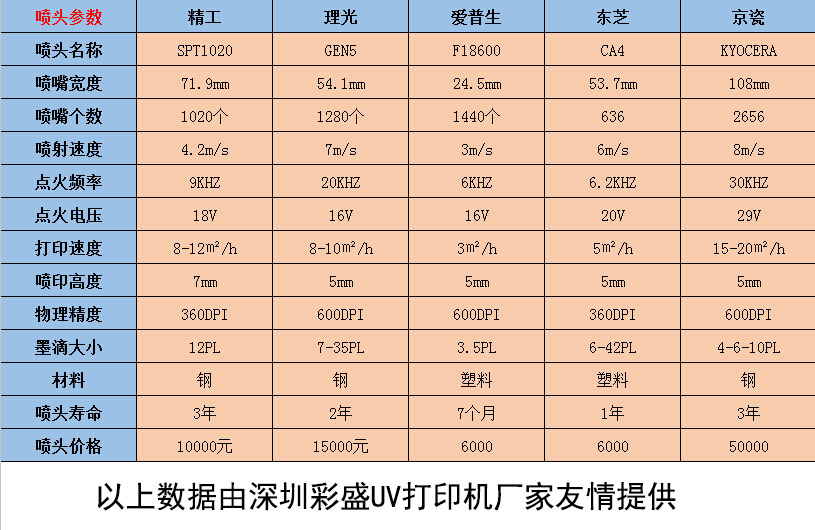
As shown in the comparison table above, Kyocera printheads offer excellent performance but are relatively expensive and have high replacement costs. Epson printheads provide high print quality but generally have a shorter service life and lower long-term stability. Among the mainstream options, the Seiko 1020 and Ricoh G5 printheads offer the best overall value for money. From the perspective of production speed and operational stability, the Seiko 1020 has a slight advantage. However, when superior print resolution and image quality are the primary priorities, the Ricoh G5 performs better. Although the Seiko 1020 does not achieve the highest print resolution available, it still delivers excellent print quality and is well suited for a wide range of applications where ultra-high precision is not the primary requirement.


