
Investment cost and profit analysis of UV printer making tile background wall
Tile background walls have become an increasingly popular interior decoration solution in recent years. Although this market has been established for some time, there are still many untapped regions with significant business potential. For entrepreneurs planning to invest in tile background wall production, it is essential to understand the investment costs, profit potential, and, most importantly, the production equipment required—especially the UV printer.
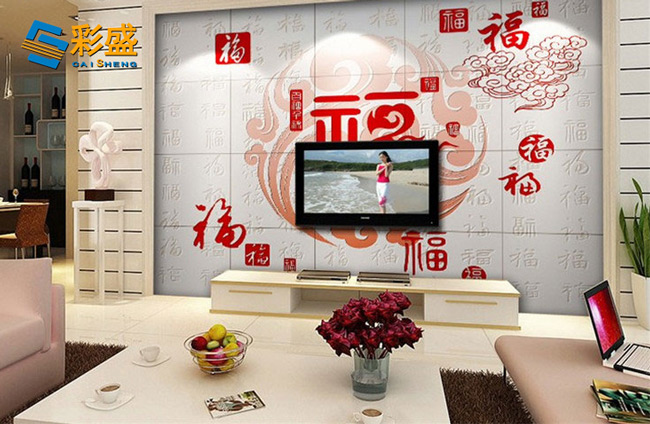
Why Is a UV Printer an Essential Production Machine?
As mentioned above, a UV printer is an indispensable piece of equipment for manufacturing tile background walls. The reason becomes clear when we look at the common production processes used in today's market.
1. Flat Color Printing. As the name suggests, this process involves directly printing colorful images onto a flat tile surface using a UV printer. After printing, the product becomes a finished decorative tile background wall. Some glossy tile background walls receive an additional UV varnish coating after printing to achieve a brighter finish. In fact, all background wall products can be coated with UV varnish to create a high-gloss appearance, while products without varnish produce a matte finish.
2. Flat Embossed Printing. The embossed effect is created by building up layers of ink to form a textured surface. First, the UV printer is programmed to print the raised areas (typically using multiple layers of black and white ink, with additional print passes producing a stronger embossed effect). Afterward, the full-color image is printed over the embossed pattern, and an optional UV varnish coating can also be applied.
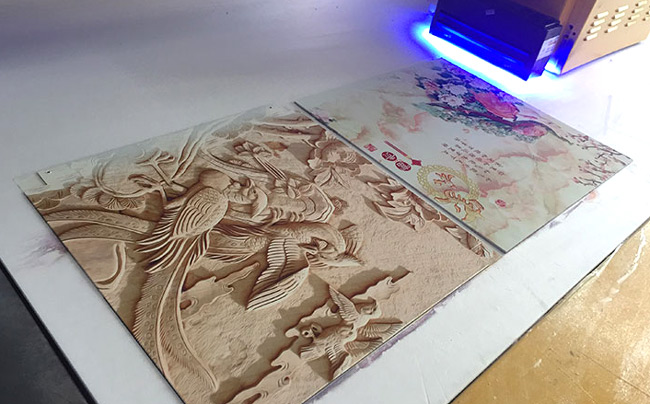
3. Color Carving. This process requires a CNC engraving machine, a sandblasting machine, and a UV printer. The engraving machine first creates the outline of the carved design, after which the UV printer accurately aligns and prints the colors onto the engraved surface. A UV varnish finish can also be added to enhance the final appearance.
4. Deep Engraving. Deep engraving uses a precision engraving machine together with a UV printer. The production process is similar to color carving, but the engraved depth is much greater, creating a stronger three-dimensional effect. Since a precision engraving machine combines both engraving and sandblasting functions, it can be used for both color carving and deep engraving applications. These products can also be finished with UV varnish.
As you can see, regardless of the production process, the one piece of equipment common to all tile background wall manufacturing methods is the UV printer.
Investment Cost and Profit Analysis for Tile Background Walls
I. Investment Costs
1. Equipment Costs. UV printers range from tens of thousands to several hundred thousand RMB depending on the configuration. For the best balance between performance and cost, machines in the mid-range price category are generally recommended. Precision engraving machines typically cost between RMB 30,000 and 60,000, while UV varnish coating machines generally range from RMB 30,000 to 70,000.
2. Raw Material Costs. Common tile sizes for decorative background walls include 600 × 600 mm and 800 × 800 mm. The average raw material cost is approximately RMB 30 per square meter.
3. Consumable Costs. UV ink generally costs about RMB 5–10 per square meter, while UV varnish costs approximately RMB 6 per square meter. Including other consumables and normal production waste, total consumable costs can be controlled at around RMB 20 per square meter.
4. Labor, Facility, and Utility Costs. Electricity consumption averages approximately 5 kWh per hour, with a production capacity of around 8 square meters per hour, resulting in utility costs of roughly RMB 1 per square meter. Assuming two workers with a combined monthly salary of RMB 10,000 and a monthly production capacity of approximately 2,080 square meters, labor costs average around RMB 5 per square meter. Including factory rental costs of approximately RMB 4 per square meter, the total operating cost can be maintained at roughly RMB 10 per square meter.
Overall, the production cost for one square meter of tile background wall is approximately RMB 60.
II. Profit Potential
Selling prices vary depending on the production process and regional market conditions. Taking Foshan, Guangdong—one of the major manufacturing centers—as an example, standard flat color tile background walls typically have an average wholesale price of around RMB 150 per square meter and a retail price of approximately RMB 200 per square meter. In many other regions, wholesale prices are generally around RMB 200 per square meter, while retail prices reach approximately RMB 250 per square meter. Premium craftsmanship and higher-end production techniques allow for even greater selling prices.
Based on the production costs and market pricing, investing in the tile background wall industry offers considerable business potential. By identifying underserved markets and continuously expanding operations, investors have the opportunity to achieve attractive returns.
Good News for the Background Wall Industry
Driven by continuous technological innovation and a commitment to shaping the future of digital printing, Hongsheng Longrun plans to introduce a brand-new machine with a new printing format. This new model is expected to provide greater value for the tile background wall industry by improving production efficiency, expanding application possibilities, and offering significant advantages over existing equipment. Stay tuned for its official launch.


