
Hongsheng Longrun teaches you how to choose UV printer ink.
When selecting consumables for a UV printer, choosing the right UV ink is especially important. Today, we will discuss how to test the stability of UV ink. Ink is a consumable used by UV printers and also the basic element of printing. Without ink, printing cannot be performed. The quality of the ink determines the final printing result and can also affect the printer itself. A large part of ink quality depends on its stability. If the stability is poor, the ink quality will inevitably be unsatisfactory. So, how can we test the stability of UV printer ink?
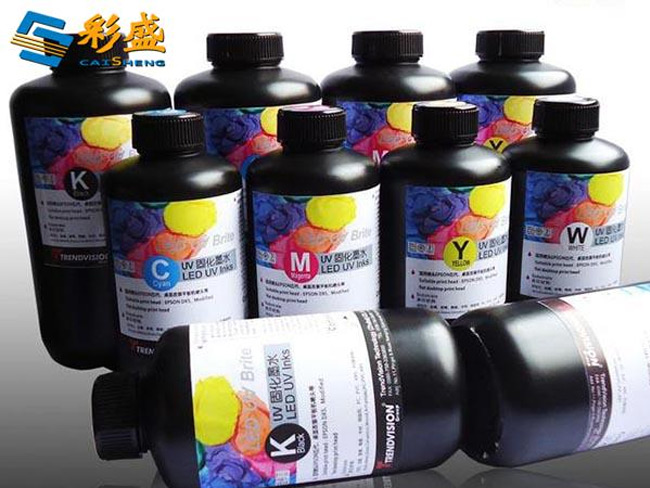
After continuous research and practical experience, Shenzhen UV printer manufacturers have summarized several practical methods for testing UV ink stability based on customer feedback. Here are some simple and useful selection methods for reference.
1. High-Temperature Test
Place the UV printer ink in a high-temperature environment between 55°C and 70°C for one week. Then return it to room temperature at 20°C to 25°C and leave it for 24 hours. After that, conduct a continuous printing test on the printer for no less than one hour. During continuous printing, the ink should not break lines or change color.
2. Low-Temperature Test
Place the UV printer ink in a low-temperature environment between -37°C and -46°C for one week. Then return it to room temperature at 20°C to 25°C and leave it for 24 hours. After that, conduct an online continuous printing test for at least one hour. During continuous printing, the ink should not break lines or change color.
High- and low-temperature testing is performed because extreme temperatures can accelerate the exposure of ink instability. These tests also help evaluate the stability of UV ink during long-term transportation and storage under high- or low-temperature conditions.
3. Identify the Ink Odor
There are two main indicators for evaluating the odor of UV printer ink. The first is the odor during application, which mainly comes from residual solvents in the UV ink. Under normal conditions, the residual solvent content should be below 2%. In special applications, such as UV ink for cigarette packaging, the requirement may be below 0.5%.
However, as raw material costs continue to rise, some suppliers may add large amounts of solvents, such as alcohol or toluene, in order to reduce UV ink production costs. In some cases, the solvent content may reach as high as 25%, which is not beneficial for the long-term development of UV printer ink or for environmental protection.
Another indicator for evaluating UV printer ink odor is whether the odor remains after printing. High-quality UV ink should not leave a strong smell that persists for a long time after application.
4. Observe the Ink Color
UV printer ink is sensitive to ultraviolet light. When printed UV ink continues to be exposed to ultraviolet light, yellowing may occur. This is one of the inherent characteristics or defects of some UV inks.
For conventional UV printer inks, this issue cannot currently be completely eliminated at the root. However, the degree of yellowing varies among different suppliers, unless special non-yellowing or extra-white UV ink is used. If the ink changes color after varnishing on a UV flatbed printer, the main cause is usually related to the ink itself.
New users should carefully review the various technical specifications of UV printer ink. Not all inks are suitable for every UV flatbed printer, and one type of ink cannot be universally applied to all printer models. Different printheads have different technical requirements for ink parameters. Therefore, it is very important to purchase UV ink that matches your printer and meets the correct technical specifications.
In addition to meeting the required physical and chemical performance standards, high-quality UV printer ink must also have excellent stability. When purchasing ink, do not blindly pursue the lowest price. Cheap ink is often made with lower-cost raw materials and may have poor quality. This can result in uneven pigment particle sizes and an unstable suspension system. Over time, or under temperature changes, the ink may separate, settle, or form layers, directly causing printhead clogging and even serious damage such as printhead burnout. Therefore, UV flatbed printers should always use high-quality ink to ensure stable performance and protect the printer.


